Compare the disciplines

Prompts Give Instructions. Loops Control Execution. Graphs Design Systems.

Prompt, loop and graph engineering solve different problems. This page sets them side by side so you can pick the right level of structure for the work in front of you — and know when the next level is worth the effort.

Windows and macOS apps are coming soon.

Side by side

Three disciplines, three jobs

Each one builds on the last. Prompts are the instructions used inside loop and graph nodes, so nothing you learn is wasted when you move up a level.

Prompt Engineering

One instruction, one response

Purpose

Design a single precise instruction — role, context, constraints and output contract — so the model returns the right result on the first pass.

Best for

  • Single-pass drafting and rewriting
  • Summaries, extraction and classification
  • Quick exploration and ideation

Strengths

  • Fastest to write and to run
  • Cheapest per result
  • Easy to read, share and reuse

Limitations

  • No self-correction between attempts
  • Quality depends on your review
  • Breaks down on long multi-part work

Loop Engineering

Repeatable, self-checking execution

Purpose

Design a bounded execution cycle — plan, execute, validate, retry — with acceptance criteria and explicit stop conditions.

Best for

  • Work that must meet a quality bar
  • Iterative refinement and self-review
  • Tasks where the first output is rarely enough

Strengths

  • Improves output across iterations
  • Validation and guardrails are explicit
  • Retries and budgets are bounded

Limitations

  • Slower and more costly than one prompt
  • One cycle handles one kind of job
  • Poor acceptance criteria loop forever

Graph Engineering

A system of coordinated nodes

Purpose

Design the architecture itself — specialised nodes, conditional routing, shared state, validators and human approval checkpoints.

Best for

  • Multi-stage, multi-role workflows
  • Conditional routing and parallel paths
  • Systems needing review and audit

Strengths

  • Separates concerns node by node
  • Whole system is visible and inspectable
  • Exports to frameworks and diagrams

Limitations

  • Most design effort up front
  • Overkill for simple one-pass tasks
  • Needs deliberate state design
Reference table

How they differ, attribute by attribute

The same seven questions answered for each discipline.

Prompt Engineering

Unit of design
A single instruction
Control flow
Straight through, one pass
Quality control
Human review after the fact
State
Whatever is in the prompt
Failure handling
Re-prompt manually
Best for
Fast, well-defined tasks
Main limitation
No self-correction

Loop Engineering

Unit of design
An execution cycle
Control flow
Repeat until criteria met or budget spent
Quality control
Built-in validation and bounded retries
State
Carried across iterations of one cycle
Failure handling
Retry strategy with stop conditions
Best for
Quality-critical repeatable work
Main limitation
Single kind of job per loop

Graph Engineering

Unit of design
A system of nodes and edges
Control flow
Conditional routing, branches and parallel paths
Quality control
Validators, quality gates and human approvals
State
Typed shared state every node reads and writes
Failure handling
Fallback paths, recovery nodes and safe termination
Best for
Complex multi-role workflows
Main limitation
Highest up-front design cost
In the app

Design all three in one place

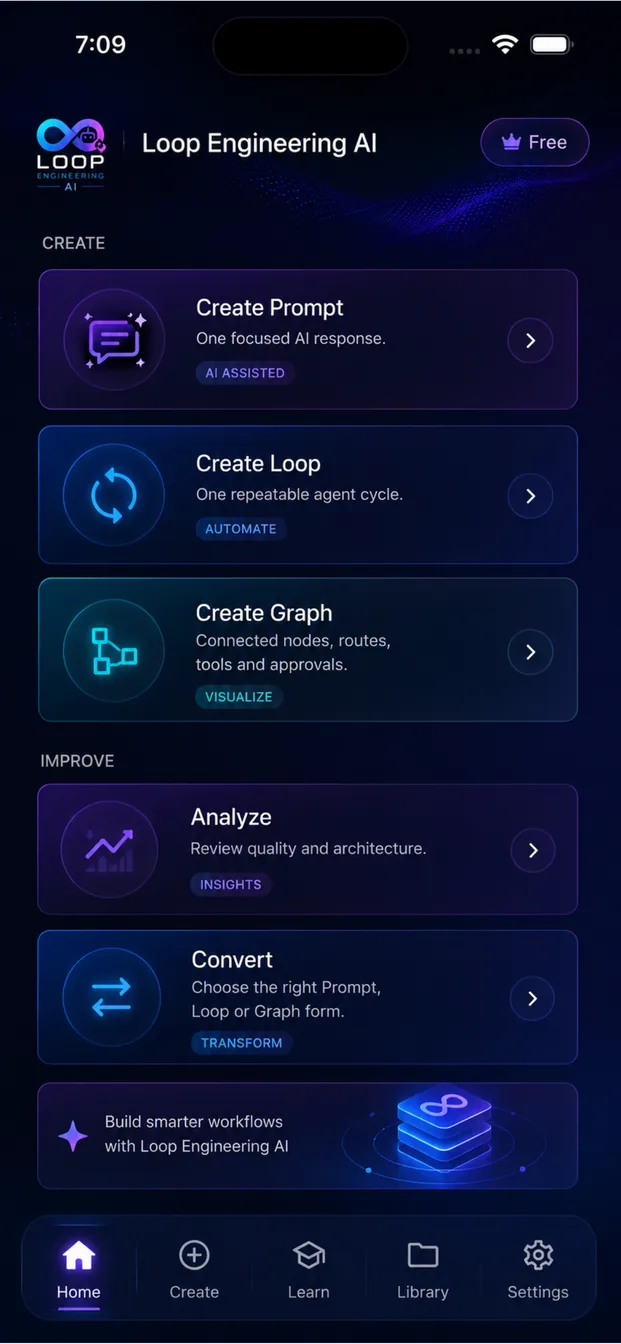
Loop Engineering AI converts between prompts, loops and graphs in either direction, so you can raise the level of structure only when the work needs it.

Loop Engineering AI home screen with Create Prompt, Create Loop and Create Graph options alongside Analyze and Convert tools
Create prompts, loops and graphs from one hub
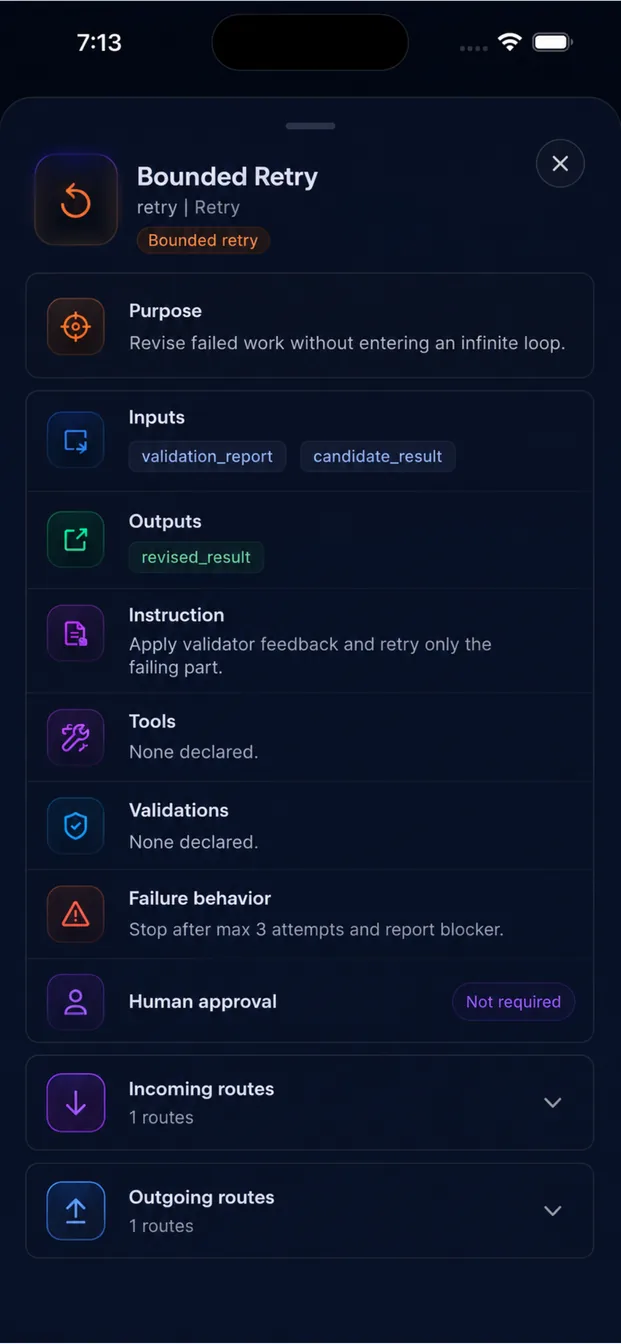
Bounded retry node detail showing purpose, inputs, outputs, instruction, validations, failure behaviour and human approval settings
A loop node with validation and bounded retries
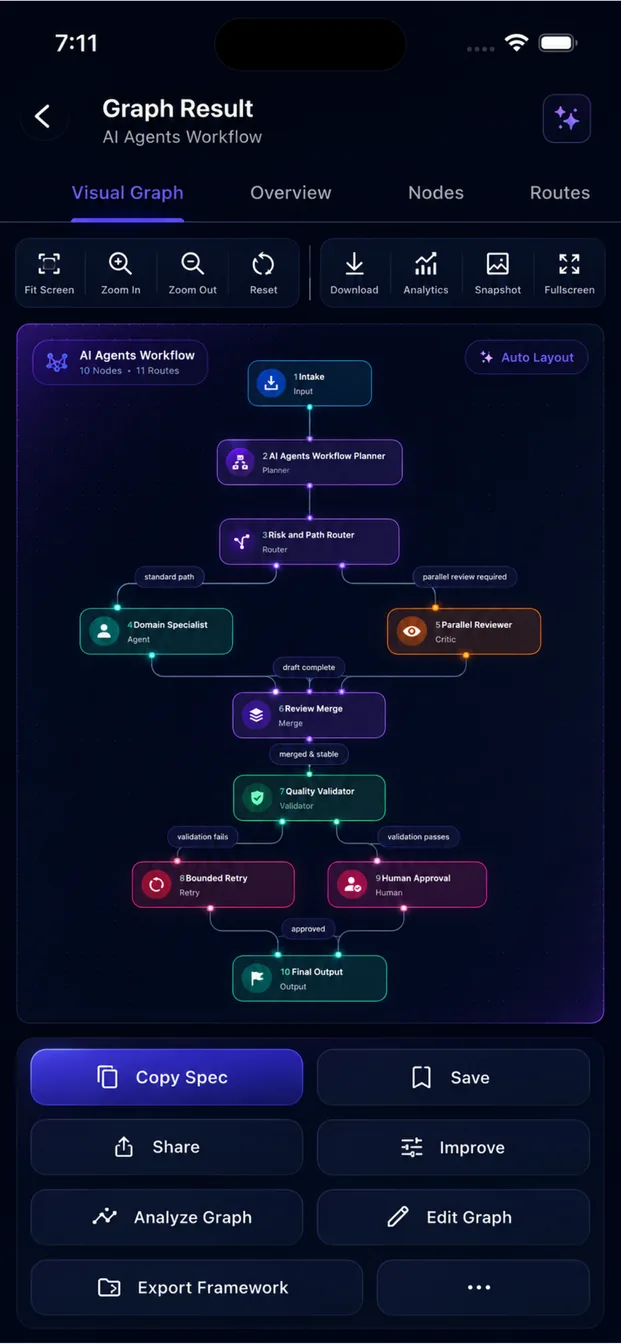
Visual graph editor showing an AI agents workflow of connected planner, router, specialist, validator and human approval nodes
A full agent graph in the visual editor
FAQ

Prompt, loop and graph engineering FAQ

Prompt Engineering designs a single instruction for a single response. Loop Engineering designs a repeatable execution cycle — plan, execute, validate, retry — with explicit stop conditions. Graph Engineering designs the whole system: multiple specialised nodes, routing between them, shared state, validators and human approvals.

Pick the right level of structure

Download Loop Engineering AI and move between prompts, loops and graphs as your work demands more.

Windows and macOS apps are coming soon.